Hiển thị các bài đăng có nhãn about. Hiển thị tất cả bài đăng

Thứ Tư, 8 tháng 5, 2013

Ark. governor didn't know about fugitive's health

LITTLE ROCK, Ark. (AP) — Arkansas Gov. Mike Beebe on Wednesday defended his request to have a 63-year-old fugitive returned from Michigan, even though the convicted killer is in poor health.

Beebe told The Associated Press he wasn't aware of Lester Stiggers' health issues when he sought to have him brought back to the Arkansas prison system he fled in 1970.

"We can't pick and choose which laws that we like and which laws that we don't like," Beebe told the AP. "And once the Department of Correction was given information about his whereabouts, and ... they requested me to sign an extradition warrant, then that's my duty and that's the law and that's what we did."

Stiggers was convicted of first-degree murder and sentenced to spend the rest of his life in prison for killing his father as a teenager in 1965. When he was granted a five-day leave from prison for good behavior, he headed to Michigan, where his mother lived. He's been there ever since — thanks to a governor who, in 1971, refused to send him back to Arkansas and its then-notorious prison system.

The AP recently found Stiggers living in a one-bedroom apartment along a busy road in the Detroit suburb of Warren, Mich. He gets by on $700 a month in Social Security benefits, usually making trips outside only to see a doctor. He needs an inhaler and 10 pills a day for his diabetes, high blood pressure and other ailments. A stocky man with thick arms, Stiggers grappled with sewer lines as a plumber until two strokes ended his working days and made his speech difficult to understand.

He was astounded to learn that Arkansas has renewed its efforts to bring him back to prison — more than four decades after then-Gov. William Milliken blocked the state's initial request.

Beebe, a Democrat, sent a letter this year to Republican Michigan Gov. Rick Snyder, seeking Stiggers after his Social Security benefits put him back on Arkansas' radar.

State prison officials said they didn't know that Stiggers was sick, either. But Department of Correction spokeswoman Shea Wilson told the AP that it's not the agency's role to make judgments about whether Stiggers should be brought back to Arkansas.

"It's our job to carry out the mandates of the court," Wilson said. "And that's simply what we're doing in our efforts to seek him."

Sara Wurfel, a spokeswoman for Snyder, said the matter was still under review and "there's not currently a timeframe for when that may be concluded."

___

Associated Press writer David Eggert contributed reporting from Lansing, Mich., and Ed White contributed reporting from Detroit.

___

Follow Jeannie Nuss at http://twitter.com/jeannienuss


View the original article here

Israel warns U.S. about Russian arms sale to Syria -report

WASHINGTON (Reuters) - Israel warned the United States in recent days that Russia plans to sell advanced ground-to-air missile systems to Syria despite Western pressure on Moscow to hold off on such a move, the Wall Street Journal reported on Wednesday.

The newspaper said U.S. officials had confirmed they were analyzing the Israeli reports but would not comment on whether they believed the sale of S-300 missile batteries was near.

No comment was immediately available from officials at the Pentagon or U.S. State Department.

The government of Syrian President Bashar al-Assad has been seeking to purchase the advanced S-300 missile batteries, which can intercept both manned aircraft and guided missiles, from Moscow for many years.

Western nations have repeatedly urged Russia to block the sale, which they argue could complicate any international intervention in Syria's escalating civil war.

The Journal said the information provided to Washington by Israel showed that Syria has been making payments on a 2010 agreement with Moscow to buy four batteries for $900 million, including a payment made this year through Russia's foreign-development bank, known as the VEB.

The paper said the package included six launchers and 144 operational missiles, each with a range of 125 miles (200 miles), with an initial shipment expected in the next three months.

While the effectiveness of Syria's aging air force is unclear, most experts believe that its air-defense missile system, which was upgraded after a 2007 Israeli strike on a suspected nuclear site, remains quite potent.

(Reporting By Andrea Shalal-Esa; Editing by David Brunnstrom)


View the original article here

Thứ Ba, 7 tháng 5, 2013

Obama: Bin Laden, Gadhafi show I’m serious about Syria

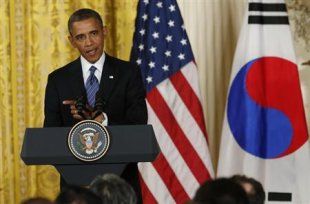
President Barack Obama faces a joint news conference in the East Room of the White House in Washington, May 7, …President Barack Obama defiantly defended his handling of Syria’s civil war on Tuesday, warning that Iraq showed the danger of acting on “perceived” evidence of weapons of mass destruction. And for those who doubt his determination to see Syrian leader Bashar al-Assad ousted from power, Obama bluntly pointed to the fate of Osama bin Laden and slain Libyan strongman Moammar Gadhafi.

"I don’t make decisions based on 'perceived' and I can’t organized international coalitions around 'perceived,'" Obama said during a joint press conference with South Korean President Park Geun-hye. "We tried that in the past, by the way and it didn’t work out well," he added, in a reference to Iraq.

Obama's comments came amid a chorus of questions and criticisms in response to the apparent use of chemical weapons by Assad's regime. The president last August labeled that kind of action a "red line" that could lead him to escalate America's role in the conflict, which the United Nations estimates has claimed the lives of at least 70,000 people. Republicans in Congress have pushed him to consider air strikes or the creation of a U.S.-enforced "no-fly zone" off limits to Syrian air power and warned that White House is sending a message of weakness to Assad.

"I would just point out that there have been several instances during the course of my presidency where I said I was going to do something, and it ended up getting done," Obama countered. "And there were times when folks on the sidelines wondering 'why hasn’t it happened yet?', and 'what’s going on?,' and 'why didn’t it go on tomorrow?'."

But in the end, Obama said, "whether it’s bin Laden or Gadhafi, if we say we’re taking a position, I would think at this point the international community has a pretty good sense that we typically follow through on our commitments." Elite U.S. commandos killed bin Laden in a May 2011 raid. And (after prodding from Congress) Obama made Gadhafi's removal a key part of the NATO-led campaign in Libya. Gadhafi was killed, apparently by Libyan rebels. Obama has provided rebels fighting to oust Assad with humanitarian aid. There have been news reports that American agents in Syria have been helping to train opposition forces and vet them to receive weapons from other countries -- a sign of caution from Washington at a time when some of the best fighters against the regime have ties to al-Qaida. But administration officials say Obama also takes a pragmatic view of what America's core interests are and a skeptical view of calls to escalate America's role.

"We have both a moral obligation and a national security interest in a) ending the slaughter in Syria but b) also ensuring that we’ve got a stable Syria that is representative of all the Syrian people, and is not creating chaos for its neighbors," Obama said Tuesday.

"Understandably, there’s a desire for easy answers. That’s not the situation there," he said. "And my job is to constantly measure our very real and legitimate humanitarian and national security interests in Syria, but measuring those against my bottom line which is what’s in the best interests of America’s security and making sure that I’m making decisions not based on a hope and a prayer but on hard-headed analysis in terms of what will actually make us safer and stabilize the region."

Obama declared that "there'd be severe costs in doing nothing. That's why we're not doing nothing."

His remarks came as the top Republican on the Senate Foreign Relations Committee, Bob Corker of Tennessee, told CBS News on Tuesday that the United States will "shortly" begin arming Syrian rebels, looking to boost moderate factions over al-Qaida-affiliated extremists whose rise would be a national security "nightmare."

"I do think we’ll be arming the opposition shortly," Corker of Tennessee said in an interview. "We’re doing a lot more there on the ground than really is known, but we do have to change the equation."


View the original article here

Thứ Hai, 6 tháng 5, 2013

All about immigration: Green cards? Citizenship?

WASHINGTON (AP) — This may be the year Congress decides what to do about the millions of immigrants living illegally in the U.S. After years of gridlock, there are ideas whizzing all around Washington.

For now, all eyes are on an 844-page Senate proposal with the you-said-a-mouthful title of the "Border Security, Economic Opportunity and Immigration Modernization Act of 2013."

Look for the Senate Judiciary Committee to take its first votes on the legislation on Thursday.

What's in that bill? Is there a Plan B? And who are all these immigrants, once you get past the big round numbers?

A big dose of facts, figures and other information to help understand the current debate:

___

WHY NOW?

Major problems with U.S. immigration have been around for decades.

President George W. Bush tried to change the system and failed. President Barack Obama promised to overhaul it in his first term but never did.

In Obama's second term, he's making immigration a priority, and Republicans also appear ready to deal.

Why the new commitment?

Obama won 71 percent of Hispanic voters in his 2012 re-election campaign, and he owes them. Last year's election also sent a loud message to Republicans that they can't ignore this pivotal voting bloc.

It's been the kind of breathtaking turnaround you rarely see in politics. Plus, there's growing pressure from business leaders, who want to make it easier for the U.S. to attract highly educated immigrants and to legally bring in more lower-skilled workers such as farm laborers.

___

WHAT'S THE PROBLEM?

Talk about "comprehensive immigration reform" generally centers on four main questions:

—What to do about the 11 million-plus immigrants who live in the U.S. without legal permission.

—How to tighten border security.

—How to keep businesses from employing people who are in the U.S. illegally.

—How to improve the legal immigration system, now so convoluted that the adjective "Byzantine" pops up all too frequently.

___

WHAT'S THE GANG OF EIGHT?

A group of four Democrats and four Republicans in the Senate that crafted a bill to address all four questions. In a nutshell, this proposal would tighten border controls, allow more high- and low-skilled workers to legally immigrate, require employers to verify their workers have legal status, and create an opportunity for those who are in the U.S. illegally to eventually become citizens.

___

IS THERE A PLAN B?

And C and D.

Obama has his own backup plan in case congressional talks fail, but he's given his support to the Senate bill as a worthy compromise.

In the House, Republican Rep. Bob Goodlatte, the head of the House Judiciary Committee, says his committee will tackle the main immigration issues one by one, instead of starting with a single sweeping bill.

Separately, there's a bipartisan House group working on legislation.

Obama says he will keep an open mind about the various proposals, but the final deal has to address all the big issues.

___

COMING TO AMERICA

A record 40.4 million immigrants live in the U.S., representing 13 percent of the population. More than 18 million are naturalized citizens, 11 million are legal permanent or temporary residents, and more than 11 million are in the country without legal permission, according to the Pew Hispanic Center, a private research organization.

Those in the U.S. illegally made up about 3.7 percent of the U.S. population in 2010. While overall immigration has steadily grown, the number of immigrants in the U.S. illegally peaked at 12 million in 2007.

___

WHERE FROM?

Twenty-nine percent of the foreign-born in the U.S., or about 11.7 million people, came from Mexico. About 25 percent came from South and East Asia, 9 percent from the Caribbean, 8 percent from Central America, 7 percent South America, 4 percent the Middle East and the rest from elsewhere.

The figures are more lopsided for immigrants living here illegally: An estimated 58 percent are from Mexico. The next closest figure is 6 percent from El Salvador, says the government.

___

WHERE TO?

California has the largest share of the U.S. immigrant population, 27 percent, followed by New York, New Jersey, Florida, Nevada, Hawaii and Texas, according to the Migration Policy Institute, a private group focused on global immigration issues.

California has the largest share of immigrants in the U.S. illegally, at 25 percent, followed by Texas with 16 percent. Florida and New York each has 6 percent, and Georgia has 5 percent, according to the Department of Homeland Security.

___

GETTING IN

Here's one way to think about the ways immigrants arrive in the U.S: Some come in the front door, others the side door and still others the back door, as laid out in a report from the private Population Reference Bureau.

—Arriving through the front door: people legally sponsored by their families or employers. Also refugees and asylum-seekers, and immigrants who win visas in an annual "diversity" lottery.

—Side door: legal temporary arrivals, including those who get visas to visit, work or study. There are dozens of types of nonimmigrant visas, available to people ranging from business visitors to foreign athletes and entertainers. Visitors from dozens of countries don't even need visas.

—Back door: Somewhat more than half of those in the U.S. illegally have come in the back door, evading border controls, Pew estimates. The rest legally entered, but didn't leave when they were supposed to or otherwise violated terms of their visas.

___

IS IT A CRIME?

Simply being in the United States in violation of immigration laws isn't, by itself, a crime; it's a civil violation.

Entering the country without permission is a misdemeanor criminal offense. Re-entering the country without authorization after being formally removed can be felony.

Pew estimates that a little less than half of immigrants who lack legal permission to live in the U.S. didn't enter the country illegally. They overstayed their visas, worked without authorization, dropped out of school or otherwise violated the conditions of their visas.

___

WHAT'S IN A NAME?

There are varying and strong opinions about how best to refer to the 11 million-plus people who are in the U.S. without legal permission.

Illegal immigrants?

Undocumented workers?

Unauthorized population?

Illegal aliens?

The last has generally fallen out of favor. Some immigrant advocates are pressing a "Drop the I-Word" campaign, arguing that it is dehumanizing to refer to people as "illegal."

"Undocumented worker" often isn't accurate because many aren't workers, and some have documents from other countries. Homeland Security reports refer to "unauthorized immigrants," but the agency also reports statistics on "aliens apprehended."

___

DEFINITIONS, PLEASE:

—Legal permanent residents (LPRs): people who have permission to live in the U.S. permanently but aren't citizens. They're also known as "green card" holders. Most of them can apply for citizenship within five years of getting green cards. In 2011, 1.06 million people got the cards.

—Refugees and asylees: people who come to the U.S. to avoid persecution in their home countries. What's the difference between the two terms? Refugees are people who apply for protective status before they get to the U.S. Asylees are people who apply upon arrival in the U.S. or later.

—Naturalization: The process by which immigrants become U.S. citizens.

___

GOING GREEN

Is there an actual green card? Indeed there is.

It's the Permanent Resident Card issued to people who are authorized to live and work in the U.S. on a permanent basis. In 2010, the government redesigned them to add new security features — and make them green again.

The cards had been a variety of colors over the years. New green cards are good for 10 years for lawful permanent residents and two years for conditional residents.

___

PATH TO CITIZENSHIP

There's a lot of talk about creating a "path to citizenship" for immigrants who are in the U.S. without legal status.

But there's vigorous debate over what conditions these immigrants should have to satisfy to get citizenship — among them are paying taxes, fines and fees, and passing background checks.

Some legislators want to set additional conditions, such as improvements in border security and in tracking whether legal immigrants leave the country when required. Others want to limit immigrants who are in the U.S. illegally to some sort of legal status that stops short of citizenship.

But more than 60 percent of Americans think those who are here illegally should have a way to become citizens, according to an Associated Press-GfK poll conducted in April.

The Senate bill would allow those in the country illegally to obtain "registered provisional immigrant" status six months after the bill was enacted if they met certain conditions.

Additional border security improvements would have to go into place before anyone obtained green cards or citizenship.

It would take immigrants living here illegally at least 13 years to get all the way to citizenship. They'd have to pay taxes, fees and $2,000 in fines. No one who entered the country after Dec. 31, 2011, or had a felony conviction or more than three misdemeanors would be eligible.

___

THE A-WORD

Nothing stirs up a hornet's nest like talk of amnesty for immigrants who are in the country illegally, although there's a lot of disagreement over how to define the term.

A 2007 effort to overhaul the immigration system, led by Bush, failed in part because Republicans were dismayed that it included a process to give otherwise law-abiding immigrants who were in the country illegally a chance to become citizens. Critics complained that would be offering amnesty.

All sides know it's not practical to talk about sending 11 million-plus people back to their countries of origin. So one big challenge this time is finding an acceptable way to resolve the status of those who are in the country illegally.

Backers of the Senate bill stress that those who are in the country illegally would have a longer and more difficult path to citizenship under their plan than would immigrants who followed all the rules.

___

GETTING A REPRIEVE

While the larger immigration debate goes on, the government already is offering as many as 1.76 million immigrants who are in the country illegally a way to avoid deportation, at least for now.

Obama announced a program in June that puts off deportation for many people brought here as children. Applicants for the reprieve must have arrived before they turned 16, be younger than 31 now, be high school graduates or in school, or have served in the military. They can't have a serious criminal record or pose a threat to public safety or national security.

Applications for the Deferred Action for Childhood Arrivals program are averaging more than 3,000 a day. By mid-April, nearly 489,000 people had applied and more than 268,000 had been approved, with most of the rest still under consideration.

Applications have come from all 50 states, with the largest number coming from California and Texas. Nearly 75 percent of the applicants are originally from Mexico.

In some ways, the program closely tracks the failed DREAM Act, which would have given many young illegal immigrants a path to legal status. Obama's program doesn't give them legal status but it at least protects them from deportation for two years.

___

HISTORY: DOING THE WAVE

The U.S. is in its fourth and largest immigration wave.

First came the Colonial era, then an 1820-1870 influx of newcomers mostly from Northern and Western Europe. Most were Germans and Irish, but the gold rush and jobs on the transcontinental railroad also attracted Chinese immigrants.

In the 1870s, immigration declined due to economic problems and restrictive legislation.

The third wave, between 1881 and 1920, brought more than 23 million people to the U.S., mostly from Southern and Eastern Europe, aided by cheaper trans-Atlantic travel and lured by employers seeking workers.

Then came the Great Depression and more restrictive immigration laws, and immigration went into decline for decades.

The fourth wave, still underway, began in 1965 with the end of immigration limits based on nationality. Foreign-born people made up 1 in 20 residents of the U.S. in 1960; today, the figure is about 1 in 8.

___

HISTORY: HERE A LAW, THERE A LAW

Until the late 1800s, immigration was largely a free for all. Then came country-by-country limits. Since then, big changes in U.S. immigration law have helped produce big shifts in migration patterns.

Among the more notable laws:

—1965 Immigration and Nationality Act: Abolished country-by-country limits, established a new system that determined immigration preference based on family relationships and needed skills, and expanded the categories of family members who could enter without numerical limits.

—1986 Immigration Reform and Control Act: Legalized about 2.7 million immigrants living in the U.S. illegally, 84 percent of them from Mexico and Central America.

—1990 Immigration Act: Increased worldwide immigration limit to a "flexible cap" of 675,000 a year. The number can go higher in some years if there are unused visas available from the previous year.

—1996 Immigrant Reform and Immigrant Responsibility Act. Expanded possible reasons for deporting people or ruling them ineligible to enter the U.S., expedited removal procedures, gave state and local police power to enforce immigration laws.

—Post-2001: In 2001, talk percolated about a new immigration plan to deal with unauthorized immigrants, guest workers and violence along the Mexican border. But the Sept. 11 terrorist attacks of 2001 put an end to that, amid growing unease over illegal immigration.

___

ABOUT LAST TIME. ...

The last big immigration legalization plan, in 1986, took six years to get done.

The law, signed by President Ronald Reagan, had three main components: making it illegal to hire unauthorized workers, improving border enforcement and providing for the legalization of a big chunk of the estimated 3 million to 5 million immigrants then in the country illegally.

The results were disappointing on two central fronts: The hiring crackdown largely failed because there was no good way to verify eligibility to work, and it took a decade to improve border security. As a result, illegal immigration continued to grow, fueled by the strong U.S. economy.

What did work as intended: Close to 3 million immigrants living in the U.S. without permission received legal status. By 2009, about 40 percent of them had been naturalized, according to Homeland Security.

___

LATINOS RISING

Census figures show that between 1960 and 2010, immigration from Europe declined while the numbers coming from Latin America and Asia took off. As the immigrants' points of origin changed, so did their destinations. Concentrations shifted from the Northeast and Midwest to the South and West.

A few Census Bureau snapshots:

—In 1960, there were fewer than 1 million people in the U.S. who were born in Latin America. By 2010, there were 21.2 million.

—In 1960, 75 percent of foreigners in the U.S. came from Europe. By 2010, 80 percent came from Latin America and Asia.

—In 1960: 47 percent of the foreign-born lived in the Northeast and 10 percent in the South. By 2010, 22 percent lived in the Northeast and 32 percent in the South.

___

THE FENCE

The fence between the U.S. and Mexico runs off and on for 651 miles along the 1,954-mile border. Most of it has been built since 2005. At some points, it's an 18-foot-high steel mesh structure topped with razor wire. At others, it's a rusting, 8-foot-high thing, made of Army surplus landing mats from the Vietnam War.

The fencing is one of the more visible manifestations of a massive effort over the past two decades to improve border security. The results of that effort are dramatic. Those images of crowds of immigrants sprinting across the border illegally while agents scramble to nab a few are largely a thing of the past.

Two decades ago, fewer than 4,000 Border Patrol agents worked along the Southwest border. Today there are 18,500.

Plummeting apprehension statistics are one measure of change: 357,000 last year, compared with 1.6 million in 2000. The numbers are down in part because fewer are trying to make it across.

The border isn't sealed but it is certainly more secure.

The Senate bill would require the government to have even tougher border security plans before those who are in the country illegally could become legal permanent residents.

___

WHO'S HANGING AROUND

With tighter border security and years of economic difficulty in the U.S., it turns out that most of the immigrants who are in the U.S. without permission have been there for a while. Just 14 percent have arrived since the start of 2005, according to Homeland Security estimates. In contrast, 29 percent came during the previous five years.

At the peak in 2000, about 770,000 immigrants arrived annually from Mexico, most of them entering the country illegally. By 2010, the pace had dropped to about 140,000, most of them arriving as legal immigrants, according to Pew.

___

WHO'S LEAVING?

Mexicans, mostly. Since 1986, more than 4 million noncitizens have been deported. Deportations have expanded in the Obama administration, reaching 410,000 in 2012 from 30,000 in 1990. Most of those deported — 75 percent — are sent back to Mexico. Nearly half of those removed had prior criminal convictions. So far, the Obama administration has deported more than 1.6 million people.

___

TO NATURALIZE OR NOT

Lots of U.S. immigrants who are eligible to become naturalized citizens don't bother. As of 2010, about two-thirds of eligible immigrants had applied for citizenship, according to the Migration Policy Institute. That lags behind the rate in other English-speaking countries such as Australia and Canada, which do more to promote naturalization.

___

WHY BOTHER?

What's so great about citizenship?

Naturalization offers all sorts of rights and benefits, including the right to vote and run for office. Naturalized citizens are protected from losing their residency rights and being deported if they get in legal trouble. They can bring family members into the U.S. more quickly.

Certain government jobs and licensed professions require citizenship. Citizenship also symbolizes full membership in U.S. society.

In 2010, there was a 67 percent earnings gap between naturalized citizens and noncitizen immigrants, according to a report from the Migration Policy Institute. Even after stripping out differences in education, language skills and work experience, naturalized citizens earned at least 5 percent more.

___

SKIPPING IT

Nearly two-thirds of the 5.4 million legal immigrants from Mexico who are eligible to become U.S. citizens haven't done so, according to a Pew study released in February. Their rate of naturalization is half that of legal immigrants from all other countries combined. The barriers to naturalization cited by Mexican nonapplicants include the need to learn English, the difficulty of the citizenship exam and the $680 application fee.

___

WORKERS

How do immigrants who are in the U.S. without permission fit into the nation's jobs picture?

In 2010, about 8 million were working in the U.S. or trying to get work. They made up about 5 percent of the labor force, according to Pew. Among U.S. farm workers, about half are believed to be in the country illegally, according to the Government Accountability Office.

Business groups want a system to legally bring in both more highly skilled workers and more lower-skilled workers such as agricultural laborers. The idea is to hire more when Americans aren't available to fill jobs. This has been a sticking point in past attempts at immigration overhaul. Labor groups want any such revamped system to provide worker protections and guard against displacing American workers. Current temporary worker programs are cumbersome and outdated.

The Senate bill would establish a agriculture worker visa system and create more visa programs for high- and low-skilled workers. Farm workers already here illegally would be able to qualify for green cards after five years if they'd already worked in agriculture in the U.S. for two years and if they kept working in the industry.

___

EMPLOYERS

Current law requires employers to have their workers fill out a form that declares them authorized to work in the U.S. Then the employer needs to verify that the worker's identifying documents look real. But the law allows lots of different documents, and many of them are easy to counterfeit.

The government has developed a mostly voluntary employment verification system called E-Verify, which has gradually gotten better. But so far just 10 percent of employers are using it, according to the Migration Policy Institute. The system is now required in varying degrees by 19 states.

The Senate proposal would require all employers to implement it within four years.

___

FAMILIES VS. JOBS

A big question in the immigration debate centers on how much priority to give to the family members of U.S. citizens and permanent residents.

Under current law, the U.S. awards a much larger proportion of green cards to family members than to foreigners with job prospects here. About two-thirds of permanent legal immigration to the U.S. is family-based, compared with about 15 percent that is employment-based, according to the Migration Policy Institute. The rest is largely humanitarian.

Some policymakers think employment-based immigration should be boosted to help the economy. Advocates for families want to make sure any such action doesn't come at the expense of people seeking to join relatives in the U.S.

The Senate plan would prevent citizens from bringing in siblings and would allow them to sponsor married sons and daughters only if the children were under 31. It would raise the cap on visas for high-skilled workers, create a startup visa for foreign entrepreneurs, and set up a new merit visa that would award points to prospective immigrants based on their education, employment, length of residence in the U.S. and other factors.

___

WHO CARES?

For all the attention being devoted to immigration right now, it's not the top priority for most people, even for most Hispanics. It ranked 17th on a list of policy priorities in a recent Pew Research Center poll. Among Hispanics, one-third said immigration was an extremely important issue to them, behind such issues as the economy and jobs, education and health care.

___

A VIEW FROM THE SOUTH

Is life actually better in the U.S.? A little more than half of Mexican adults think so, according to a 2012 Pew Global Attitudes poll. Thirty-eight percent said they'd move to the U.S. if they had the chance. Nineteen percent said they'd come even without authorization.

___

Sources: Pew Hispanic Center, Migration Policy Institute, Department of Homeland Security, Census Bureau, Government Accountability Office, Population Reference Bureau, Encyclopedia of Immigration.

___

Associated Press writers Alicia Caldwell and Erica Werner contributed to this report.

___

Follow Nancy Benac on Twitter: http://www.twitter.com/nbenac


View the original article here

Chủ Nhật, 28 tháng 4, 2013

Syria's neighbors cautious about U.S.-led intervention

By Nick Tattersall

ISTANBUL (Reuters) - Syria's neighbors, wary of stirring a conflict that could spill back over their borders, would be reluctant partners in a U.S.-led intervention but are ultimately likely to support limited military action if widespread use of chemical weapons is proven.

The White House disclosed U.S. intelligence on Thursday that Syria had likely used chemical weapons, a move President Barack Obama had said could trigger unspecified consequences, widely interpreted to include possible U.S. military action.

Syrian neighbors Jordan and Turkey, their support key in any such intervention, have long been vocal critics of Bashar al-Assad. Prime Minister Tayyip Erdogan, an erstwhile ally of the Syrian President, was among the first to call openly for his overthrow while allowing armed opponents to use Turkish soil.

But their rhetoric has been tempered by the changing circumstances of a war that has dragged on beyond their expectations and grown increasingly sectarian, as well as by the suspicion they will be left bearing the consequences of any action orchestrated by Western powers thousands of miles away.

For Turkey's leaders, facing elections next year, talk of chemical weapons is an uncomfortable reminder of the wave of anti-U.S. sentiment which followed the 2003 U.S.-led invasion of Iraq, justified by intelligence on nuclear, chemical and biological weapons that turned out to be erroneous.

Turkey, which shares a 900-km border with Syria, has reacted cautiously to the U.S. disclosure while Jordan, fearful of the growing influence of radical Islamists in the Syrian rebel ranks, has voiced its preference for a political solution.

"The international community, and especially the peoples of the Middle East, have lost confidence in any report which argues that there are weapons of mass destruction or chemical weapons," said one source close to the Turkish government.

"Right now, no-one wants to believe them. And if Assad uses chemical weapons some day ... I still think Turkey's primary reaction would be asking for more support to the opposition rather than an intervention."

Turkey's rhetoric on Syria, at least in public, has toned down markedly over the past six months, even as shelling and gunfire spilled over the border and the influx of refugees to camps on its territory swelled to a quarter of a million.

Foreign Minister Ahmet Davutoglu's push for a foreign-protected "safe zone" inside Syria gained little traction among allies and appears to have quietly slipped from the agenda. Even Erdogan, whose speeches were regularly laced with bellicose anti-Assad rhetoric, mentions the conflict less frequently.

But many analysts believe both the pro-U.S. monarchy in Jordan and Erdogan's government in Ankara would toe the line should Washington seek their cooperation in military action.

Turkey's relations with Washington have at times been prickly - notably in 2003 when it failed to allow the deployment of U.S. forces to Turkey to open a northern front in the Iraq war - but strategic cooperation has generally remained strong.

Turkish support and bases proved vital, for example, to U.S. forces in Afghanistan, while Turkey hosts a U.S.-operated NATO radar system to protect against any regional threat from Iran.

"Given the texture of the current government's relations with the U.S. and given the history of its discourse on Syria, I think it would be not impossible but rather difficult for Mr Erdogan not to oblige U.S. demands," said Faruk Logoglu, former Turkish ambassador to Washington and vice chairman of the main opposition Republican People's Party.

RELUCTANT PARTNERS

Although Obama has warned Syria that using chemical weapons against its own people would cross a "red line", he has also made clear he is in no rush to intervene on the basis of evidence he said was still preliminary.

Syria denies using chemical weapons in the two-year-old conflict in which more than 70,000 people have been killed.

Mindful of the lessons of the start of the Iraq war, aides have insisted Obama will need all the facts before deciding what steps to take. But acknowledgment of the intelligence assessment appears to have moved the United States closer - at least rhetorically - to some sort of action, military or otherwise.

Turkey and Jordan would be key to any such move, but they may prove reluctant.

From the outset, Turkey has felt slighted.

Before the crisis, Erdogan cultivated a friendship with Assad, personal ties which he tried to use after the start of the uprising in March 2011 to persuade the Syrian leader to embrace reform and open dialogue. He was rebuffed.

When his strategy changed, he began calling for Assad's removal and allowing the Syrian opposition to organize on Turkish soil. Ankara felt it gained praise from Washington and its allies but little in the way of concrete support.

"Turkey feels lonely in many senses," the Turkish source said, saying that a military intervention now would leave Turkey and Syria's other neighbors reeling from the consequences.

"There is always the risk of creating more destruction and creating a failed state in Syria ... This thing is happening next door. The flames are reaching us, starting to burn us, where they can't reach the United States, Qatar, or the UK."

Jordan's King Abdullah said last year Assad should step down, but the kingdom is increasingly concerned by the growing strength in Syrian rebel ranks of Islamist fighters who view the monarchy with just as much hostility as they do Assad.

Further fuelling those fears is the presence of fighters from the Nusra Front, which has declared its allegiance to al Qaeda leader Ayman al-Zawahri, among rebels who have taken territory across Syria's southern province of Deraa, only 120 km (75 miles) from the Jordanian capital Amman.

Officials fear Syria has become a magnet for Islamist fighters who could one day turn their guns on Jordan - as Jordanian-born Abu Musab al-Zarqawi did during the sectarian conflict in neighboring Iraq. Zarqawi was widely believed to have been behind simultaneous attacks on Jordanian tourist hotels which killed dozens of people in November 2005.

SENSE OF URGENCY

Such fears could push the U.S. and its allies to act.

"The fact that the opposition is divided cuts both ways. It makes the logistics and even the politics of an intervention more difficult," said Sinan Ulgen of the Istanbul-based Center for Economic and Foreign Policy Studies (EDAM).

"But at the same time it reinforces the urgency of an intervention: the more the international community does not intervene in Syria, the more likely it is that the radical elements will gain the upper hand in a post-Assad Syria."

Turkish officials and diplomats have expressed concern about the role Saudi Arabia may be playing in providing weapons which are going to the hands of radical Islamist elements among the Syrian rebel ranks.

U.S. intelligence agencies believes Assad's forces may have used the nerve agent sarin on a small scale against rebel fighters. The fear is that an increasingly desperate Assad may use such weapons more widely the longer the conflict drags on.

An attack like that on the Iraqi Kurdish city of Halabja - where an estimated 5,000 people died in a poison gas attack ordered by former Iraqi President Saddam Hussein 25 years ago, the most notorious use of chemical weapons in the Middle East in recent history - could sway public opinion in the region.

"A major chemical attack would outrage the Arab and Muslim street ... It would be difficult just to watch, then everyone would intervene," said retired Jordanian air force general Mamoun Abu Nowar.

The role Turkey or Jordan would play in any military action will depend on Washington's strategy, but logistical support for limited missile strikes or possible assistance in enforcing the sort of no-fly zone long advocated by Turkey appear more likely than sending in ground troops.

Turkey is home to NATO's second-largest army and to the Incirlik Air base, which provided logistical support for U.S. troops in Iraq and Afghanistan. It is already hosting hundreds of U.S. soldiers operating part of a NATO Patriot missile system to defend against possible Syrian attack.

Washington meanwhile announced last week it was sending an army headquarters unit - which could theoretically command combat troops - to Jordan, bolstering efforts started last year to plan for contingencies there as Syria's conflict deepens.

"A surgical strike to get the stocks of chemical weapons ... or establishing air superiority through a number of strikes against Syrian air defenses, this is the type of scenario being contemplated in Turkey," said EDAM's Ulgen.

"Anything beyond that is much more difficult to see."

(Additional reporting by Suleiman al-Khalidi and Khaled Oweis in Amman; Writing by Nick Tattersall)


View the original article here

Thứ Sáu, 26 tháng 4, 2013

Israel wary quiet on Syrian front about to end

ALONEI HABASHAN, Golan Heights (AP) — Against a vista of green fields and snowcapped mountains, all is silent but for a gusting wind. Then comes a burst of gunfire from the Syrian civil war raging next door, where jihadist rebels are battling Bashar Assad's troops in a village.

Watching it all unfold from a few kilometers (miles) away are Israeli soldiers atop tanks behind a newly fortified fence, while a large-scale Israeli drill sends off its own explosions in the background.

This is the new reality on the Israeli-occupied Golan Heights, for 40 years the quietest of Israel's front lines, a place of hiking trails, bird-watching, skiing and winery tour. The military predicts all that will soon change as it prepares for the worst — a power vacuum in Syria in which rogue groups could get their hands of the country's large stockpile of chemical weapons.

In many ways, a new era has already begun. The Syrian villages along the border change hands between military and rebel strongholds in daily battles. Their mortar shells and bullets frequently land on the Israeli side, including in in some cases narrowly missing soldiers and civilians. A Syrian army tank shell landed in the border community of Alonei Habashan in February.

Though Israel believes these have mostly been cases of errant fire, it has responded with firepower of its own on several occasions in the first round of hostilities since a long-term armistice took hold after the 1973 Mideast war.

"This area became a huge ungoverned area and inside an ungoverned area many, many players want to be inside and want to play their own role and to work for their own interests," said Gal Hirsch, a reserve Israeli brigadier general who is involved in the military's strategic planning and operations. "Syria became a place that we see as a big threat to Israel and that is why we started to work in the last two years on a strong obstacle, on our infrastructure, in order to make sure that we will be ready for the future. And the future is here already."

Officials say the military's present deployment on the plateau is its most robust since 1973, and its most obvious manifestation is the brand new border fence, 6 meters (20 feet) tall, topped with barbed wire and bristling with sophisticated anti-infiltration devices. The previous rundown fence was largely untested until it was trampled over last year by Syrians protesting on behalf of Palestinians.

The military would not detail other measures it is taking, but stressed it was actively defining the new border arrangement now, before it's too late.

On the other side of the frontier, the village of Bir Ajam is in rebel hands and Israeli troops report watching them successfully deflect Syrian military pre-dawn raids almost daily. In a village nearby, Syrian intelligence and commando forces are based in concrete, windowless structures.

At the triangle where the borders of Israel, Syria and Jordan meet along the Yarmouk River, a lone jeep is seen crossing uninterrupted from Jordan into Syria. In March, rebels kidnapped 21 Filipino U.N peacekeepers nearby. Thousands of refugees have used the route to flee the carnage into Jordan.

A few injured refugees have trickled into the Golan, and the military runs a field clinic to treat them. But there's no guarantee the trickle won't become a flood if Jordan in the south or Turkey in the north become unreachable.

"Syria right now is a kind of self-evolving system," Hirsch said. "No one can control or predict everything."

Israel, which borders southwestern Syria, has thus far been careful to stay on the sidelines of a civil war that has already claimed the lives of more than 70,000.

Assad is a bitter enemy, an ally of Iran and a major backer of Lebanese Hezbollah guerilla attacks against Israel. But like his father whom he succeeded as president, he has faithfully observed U.S.-brokered accords that ended the 1973 war. Israel worries that whoever comes out on top in the civil war will be a much more dangerous adversary.

Chief among Israeli concerns is that Assad's advanced weaponry could reach the hands of either his ally, the Hezbollah militant group in Lebanon, or Islamic extremist groups among the rebels trying to oust him.

"Syria is not a regular place ... it is the biggest warehouse for weapons on earth," Hirsch warned.

In an interview with BBC TV last week, Prime Minister Benjamin Netanyahu called the rebel groups among "the worst Islamist radicals in the world."

"So obviously we are concerned that weapons that are ground-breaking, that can change the balance of power in the Middle East, would fall into the hands of these terrorists," he said.

This week, a senior Israeli military intelligence official said Assad used chemical weapons last month. After initial denials, American and British officials confirmed the assessment of Brig. Gen. Itai Brun, the head of research and analysis in Israeli military intelligence, that the lethal nerve agent sarin was probably used. U.S. President Barack Obama has warned that the introduction of chemical weapons by Assad would be a "game changer" that could usher in greater foreign intervention in the civil war.

For Israel, the specter of peace with Syria disintegrating adds to a growing sense of siege.

It saw the Gaza Strip fall to the militant Hamas movement in an election in 2006. And Egypt, the most populous Arab country and the first to make peace with Israel, is now ruled by the fiercely anti-Israeli Muslim Brotherhood. Israel has all but admitted that its warplanes destroyed a shipment of anti-aircraft missiles believed to be headed from Syria to Hezbollah in Lebanon in January, and on Thursday it shot down a drone which it claimed was operated by Hezbollah. (Hezbollah denied launching it.).

Hirsch, who commanded an Israeli division in a monthlong war with Hezbollah in 2006, said war regional roles have since then been reversed. While once Syria used Hezbollah in Lebanon as a proxy against Israel, Hezbollah is now deterred from acting on Lebanese soil for fear of Israeli retribution and is preparing to use the instability in Syria as its future staging ground.

"The fighting in Syria gives them an opportunity to open a new front against Israel," said Hirsch. "We must be ready for turbulence. We must be ready for the Iranian involvement inside Syria. We must be ready to be able to fight against radical fundamentalist activities that will come from Syria, and that is what we are doing here."

___

Follow Heller on Twitter (at)aronhellerap


View the original article here

Reclusive death penalty lawyer opens up about work

LOS ANGELES (AP) — Judy Clarke is in the business of cheating death, but she rarely talks about it.

Clarke, one of the nation's top lawyers and defender of the despised, broke her silence Friday in a speech at a legal conference, where she spoke about her work saving notorious criminal defendants from execution.

The names of her past clients — Susan Smith, Unabomber Theodore Kaczynski and most recently, Tucson shooter Jared Loughner — run like a list of the most reviled in American criminal history. But she did not say whether she would add to that list the latest name in the news: The suspect in the Boston Marathon bombing.

Clarke was reticent throughout her keynote speech and declined to take questions from the audience. Instead, she talked about how she had been "sucked into the black hole, the vortex" of death penalty cases 18 years ago when she represented Smith, who drowned her two children.

"I got a dose of understanding human behavior and I learned what the death penalty does to us," she said. "I don't think it's a secret that I oppose the death penalty. "

She saved Smith's life and later would do the same for Kaczynski, Loughner and the Atlanta Olympics bomber Eric Rudolph. All received life sentences instead of death.

Before an audience of lawyers, judges and law students at Loyola Law School's annual Fidler Institute, Clarke shared her approach in handling death penalty cases.

"The first clear way death cases are different is the clients," said Clarke, now a visiting professor at Washington and Lee University School of Law in Virginia. "Most have suffered from serious severe trauma, unbelievable trauma. We know that from brain research. Many suffer from severe cognitive development issues that affect the core of their being."

She added that they had another thing in common: When she first meets them, they do not want to plead guilty. Her job is to change their resolve, she said.

"They're looking into the lens of life in prison in a box," she said. "Our job is to provide them with a reason to live."

Connecting with the client by finding out "what brought them to this day that will define the rest of their lives" is the first step, she said. In most cases, she said she finds underlying mental illness. Kaczynski was ultimately diagnosed as schizophrenic and, on the eve of seating a jury, he agreed to plead guilty.

Clarke said a veteran lawyer once told her: "The first step to losing a capital case is picking a jury.

The San Diego-based attorney often appears in court as a federal public defender, and appealed to judges in the audience to provide sufficient funding for death penalty cases. She also told defense lawyers and students that death penalty clients deserve their loyalty.

"Our clients are different," she said. "We should enjoy the opportunity to step into their lives. It can be chaotic. But it's a privilege to be there as a lawyer."


View the original article here

Chủ Nhật, 7 tháng 4, 2013

Arianna Huffington's Pet Peeve: People Bragging About Working 24/7

Arianna Huffington, president and editor-in-chief of The Huffington Post Media Group, told ABC News' Benjamin Bell that her biggest pet peeve is "people who pride themselves at working 24/7."

"You know, people who say, 'Oh, I don't need sleep,' 'I can just work around the clock.' And they use this, especially men, as a virility symbol, you know. I was having dinner with a guy recently and he bragged that he only got four hours of sleep the night before. And I didn't say it, but I thought to myself, 'You know what, if you had gotten five this dinner would have been a lot more interesting.' So I think the fact that people brag about how they over-work and they don't notice that this is making them less healthy and less effective is a pet peeve."

Huffington sat down for a web exclusive interview on Sunday, answering viewer questions from Facebook and Twitter, after her appearance on the "This Week" roundtable. She responded to a variety of questions regarding her perspective as a Greek-American, the Huffington Post news site as well as her Saturday Night Live doppelganger and her "real life" love for Seth Meyers.

Read More Below:

Q: Soultana Nolidis: What distinguishes a Greek-American vantage [point] in a sea of diverse views, opinions [and] perspectives?

A: "Well, definitely, the fact that I'm an immigrant in this country. That I've been blessed to live the American dream makes me very sensitive to many issues. Not just immigration issues, but what's happening to the middle class. The fact that right now…the middle class is actually suffering, and…instead of seeing upward mobility, which is a big part of the American dream, we're seeing downward mobility. And that's why everything I said on the show today had to do with prioritizing jobs, prioritizing growth. Because these are like keys for the lives of millions of Americans."

Q: Ilene Angel: Has the enormity of the success of HuffPost changed your view of the media and its responsibility?

Katherine Dobay Edmiston: Why does she lower the tenor of her website with such features as those devoted to catching celebrities revealing their flesh, either accidentally or intentionally?

A: "Well, first of all, we feel that putting our community at the center of everything we do, we've made the Huffington Post very engaging. So the Huffington Post now has almost 50 million unique visitors, is not just about us talking to our readers. It's about listening to our readers and giving them a platform where they can express themselves."

"Also, the Huffington Post is unapologetically a mixture of high-brow and low-brow. We believe that people want a mixture of everything and it's up to them to decide what to click on."

Q: Miguel Gomez: Could Julian Castro mount a challenge against Hillary just like an unknown Illinois [state] senator who also delivered the keynote at the 2004 Democratic National Convention did?

A: "You know anything is possible. Obviously, Hillary Clinton, if she decides to run, it appears she's already running, would be the presumptive nominee. But as we saw in 2008, the presumptive nominee did not turn out to be the nominee. So it's a long way between now and 2016."

Q: Tom Dwyer: When will she go on 'SNL' and do 'Weekend Update' with [Nasim Pedrad] that does a spot on impersonation of her?

A: "I think she does an amazing impersonation of me. And I also think the writing is so funny. I love Seth Meyers in real life as much as on SNL pretend life. It's a fun, fun segment."

Lightning Round:

Q: Favorite show?

A: "Veep. Julia Louis-Dreyfus on HBO."

Q: Guilty pleasure?

A: "My guilty pleasure is spending a large part of the weekend in bed-even doing my work sometimes, reading books that have nothing to do with work, and just kind of completely luxuriating without having to get out, get dressed, get makeup or anything like that."

Q: Biggest misperception about you?

A: "The biggest misperception about me is that I have a funny accent."

Viewer questions have been edited, shortened and condensed in some cases.

abc arianna huffington this week web extra jt 130407 wblog Arianna Huffingtons Pet Peeve: People Bragging About Working 24/7Arianna Huffington

Like "This Week" on Facebook here. You can also follow the show on Twitter here.

Also Read

View the original article here

Thứ Ba, 2 tháng 4, 2013

Muslims worry about broader France headscarf ban

LE BOURGET, France (AP) — Because of her choice to wear a headscarf, Samia Kaddour, a Muslim, has all but abandoned trying to land a government job in France. Soon, some private sector jobs could be off limits, too.

French President Francois Hollande says he wants a new law that could extend restrictions on the wearing of prominent religious symbols in state jobs into the private sector. His new tack comes after a top French court ruled in March that a day care operator that gets some state funding unfairly fired a woman in a headscarf, sparking a political backlash.

As Christians celebrated Easter on Sunday, Kaddour attended the four-day Annual Meeting of Muslims of France in Le Bourget, north of Paris. The convention, which last year drew some 160,000 faithful and was expected to grow this year, is billed as the largest annual gathering of its kind in Europe. It is in its 30th year and ended Monday.

French law bars state employees from wearing prominent religious symbols such as Muslim headscarves, Jewish skullcaps or large Christian crosses in public schools, welfare offices or other government facilities. Two years ago, France banned Muslim veils that cover faces, such as the niqab, which has a slit for the eyes, or the mesh-screen burqa, from being worn anywhere in public.

Meeting leaders say France has made progress in accepting Muslims and noted that, unlike 30 years ago, women wearing headscarves today rarely draw suspicion, scowls or curiosity. Still, many Muslims — and even some Roman Catholics and Jews — fear France's insistence on secular values first enshrined in the French Revolution more than two centuries ago is unfairly crimping their ability to express their religious beliefs freely.

They also worry that Hollande's Socialist government, like a conservative one before it, wants to score political points.

Most mainstream politicians insist Islam is not being targeted. But a backlash erupted after the Court of Cassation ruled in March that Baby Loup, a private-sector day care operator that gets some state funding, unfairly fired a woman who wore a headscarf to work. The far-right railed at the decision, and even Interior Minister Manuel Valls expressed regret over it.

Wading into the debate in a prime-time TV interview on Thursday, Hollande suggested new limits are needed on Muslim headscarves, saying that "when there is contact with children, in what we call public service of early childhood ... there should be a certain similarity to what exists in (public) school."

"I think the law should get involved," he added.

Many Muslims fear an encroaching Islamophobia, while proponents of such measures insist they counter extremism and act as a rampart to protect France's identity against inequality. Polls show that most French people support at least some restrictions on religious symbols.

France, with an estimated 5 million-6 million Muslims whose families mostly have origins in former French colonies in north Africa, is at the forefront of addressing the challenges that many European countries are facing about how to integrate their sizeable ethnic and religious minorities on a continent where white Christians have dominated the political landscape for centuries.

Bristling against stereotypes in many corners of the West that Muslims are closet radicals or even terrorists, leaders of the convention in Le Bourget preached peace and justice. And after prayers and praise of Islam's Prophet Muhammad, convention leaders led a song in Arabic in a vast meeting hall with thousands in the audience — and some up on the dais waved French flags.

In another convention hall, vendors offered items such as headscarves, sweet pastries or T-shirts emblazoned with the saying 'Don't Panic, I'm Muslim,' while mothers pushing strollers and others wandered through the crowd. Nearby, men kneeled in rhythmic unison for afternoon prayers. Several other stalls took up political issues such as support for Palestinians or war-weary Syrians.

In an interview, Kaddour said many Muslims regret that their faith is in the political crosscurrents again in France.

"Islam has become a political instrument," said the 26-year-old, who is a community activist from the English Channel port city of Le Havre and one of 10 children of Algerian-born parents who moved to France for plentiful jobs during its economic boom times decades ago. "Islam is always brandished whenever there is internal political discord."

"I'm not discouraged enough yet to want to leave France — many others feel that way too: We are French and we have our place to claim and our future to establish in France," she said. "I'm not a foreigner. I'm French. I want to live in France, I love this country. Even if it has trouble liking us, we are going to do what's necessary to live serenely in France."

Kaddour says she plans to go back to school to get a higher degree, but has all but given up hopes for a state job. And in France, that matters: the European Union says more than half of France's gross domestic product comes from government spending — potentially curbing the work options for headscarf-wearing Muslims such as Kaddour if the ban is broadened.

"A state job, unfortunately..." she said, her voice trailing off. "When I go into job interviews, I wear my headscarf. No results." She admits that she doesn't always know why — it could just be her skill set isn't sufficient — but suspects her religion plays a role, too.

Kaddour says her future career seems increasingly limited to independent, private practice work. She currently works for a small community group devoted to improving understanding of Islam, called Le Havre de Savoir, or The Haven of Knowledge, playing on the city's name.

At a time of double-digit unemployment rates in France, such restrictions to job access hit headscarf-wearing women especially hard: Muslim men in France don't usually wear visible religious garb.

Ahmed Jaballah, the head of the Union of Islamic Organizations of France, a major Muslim group that helped organize the conference, said the "rather morose ambiance" over France's sluggish economic growth recently hasn't helped Muslims' aspirations, suggesting that a search for scapegoats is politically appealing. He said he's concerned about the government's plans.

"Unfortunately, Muslims have the impression today that secularism is being shaped based on Muslim practices, and that's worrisome," he said in an interview. "Everybody always talks about secularism, how it's not just about Muslims. But in fact, Muslims are targeted. Nobody is fooled."

"Muslims wonder: Can we trust secularism?" he said. "Remember the French slogan: 'Liberte, Egalite, Fraternite.' Today, we want this fraternity to be real."


View the original article here

Chủ Nhật, 17 tháng 3, 2013

Palestinians unenthusiastic about Obama visit

RAMALLAH, West Bank (AP) — President Barack Obama will find a disillusioned Palestinian public, skeptical about his commitment to promoting Mideast peace, when he visits the region.

Obama's trip, beginning Wednesday, appears aimed primarily at resetting the sometimes troubled relationship with Israel. But winning the trust of the Palestinians, who accuse him of unfairly favoring Israel, could be a far more difficult task.

After suffering disappointments during the first Obama administration, Palestinians see little reason for optimism in his new term. The White House announcement that Obama will not present any new peace initiatives strengthened their conviction that the U.S. leader isn't prepared to put the pressure on Israel that they think is necessary to end four years of deadlock in negotiations.

"Obama is coming for Israel, not for us," said Mohammed Albouz, a 55-year-old Palestinian farmer. "Obama will come and go as his predecessors did, without doing anything."

While Israel is preparing to give Obama the red-carpet treatment, there are few signs of excitement in the West Bank. Large posters of Obama hung in Ramallah last week were quickly defaced, and a small group of activists called "The Campaign for Dignity" plans on releasing black balloons into the air in a sign of mourning when Obama arrives.

Obama himself played a role in reaching the current deadlock, which stems in large part from disagreements over Israeli settlement construction in the West Bank and east Jerusalem. The Palestinians claim both areas, captured by Israel in the 1967 Mideast war, as parts of a future state, a position that is widely backed internationally.

When Obama first took office, he strongly and publicly criticized the Israeli settlements, saying the construction undermines hopes for peace. "It is time for these settlements to stop," Obama said in a high-profile address to the Muslim world delivered in Cairo just months after taking office.

Emboldened by Obama's tough stance, the Palestinians said they would not negotiate with Israel's prime minister, Benjamin Netanyahu, unless settlement construction was frozen.

Obama persuaded Netanyahu to impose a 10-month slowdown, but Palestinians did not agree to restart talks until the period was nearly over. When the Israeli moratorium expired several weeks later, Netanyahu rejected American appeals to extend the slowdown, and the negotiations collapsed.

Obama stopped pushing the matter, and talks have never resumed, and the Palestinians, viewing Obama as afraid to take on Israel's allies in Washington, have few expectations now.

"What we are going to tell him behind closed doors is what we are saying in public. There is no secret that a successful peace process needs a complete settlement freeze," said Nabil Shaath, a top adviser to President Mahmoud Abbas. "The Israelis are building on our land and claiming they want to negotiate with us about this land."

More than 500,000 Israelis now live in settlements in the West Bank and east Jerusalem. The Palestinians say the ever-growing settlements are a sign of bad faith and make it increasingly difficult to partition the land between two peoples.

Netanyahu maintains that negotiations must resume without preconditions, and the fate of the settlements should be one of the issues on the table. He notes that previous rounds of negotiations have gone forward without a construction freeze.

Obama will get a firsthand glimpse of settlements when he heads to the Palestinian city of Ramallah on Thursday. The 20-minute drive from Jerusalem passes by sprawling settlements that are home to tens of thousands of Israelis.

Obama is scheduled to meet with Palestinian leaders and visit a youth center. He plans to head to the West Bank town of Bethlehem the next day to see the Church of the Nativity, built on the site where Christian tradition says Jesus was born.

Netanyahu, who was re-elected in January, has said he will make a renewed push for peace in his new term. His new government, which takes office this week, is sending mixed signals.

On one hand, he has named former Foreign Minister Tzipi Livni, a political centrist who has good working relations with the Palestinians, as his chief negotiator. The biggest partner in his coalition, the centrist Yesh Atid Party, has demanded the new government make a serious attempt to restart talks.

At the same time, Netanyahu's own Likud-Yisrael Beitenu bloc is dominated by hard-liners who oppose major concessions to the Palestinians. Another partner, the Jewish Home Party, is linked to the settler movement and would reject any attempts to freeze construction, much less hand over West Bank territory to the Palestinians.

Saeb Erekat, the chief Palestinian negotiator, said getting talks back on track will require a deeper and long-standing effort by the president and his new secretary of state, John Kerry, who is expected back in the region in April.

"We really hope that President Obama and Secretary Kerry can succeed in reviving a meaningful peace process, succeed in having Netanyahu saying the sentence that he accepts the two states in the 1967 borders," Erekat said. "We don't need new plans. We need commitment."

The gaps between Israel and the Palestinians are just one of many obstacles. The Palestinians are also deeply divided between Abbas' government in the West Bank, which favors a negotiated agreement with Israel, and the rival Hamas government in the Gaza Strip, which rejects peace with Israel. Hamas has controlled Gaza since expelling Abbas' forces in 2007.

Yehia Moussa, a senior Hamas official in Gaza, told the pro-Hamas "Felesteen" newspaper the Obama visit was meant to "cool down" the Palestinians "by giving empty promises that will assist with continuing the (Israeli) occupation."

Hani Masri, a prominent Palestinian commentator in the West Bank, said the visit might lead to some movement.

"Most likely we are going to see some life in the negotiations," perhaps a limited settlement freeze that forces Abbas to resume talks. "But such a process won't lead to a peaceful settlement."


View the original article here

Thứ Tư, 13 tháng 3, 2013

Pope captivates crowds with 1st words about peace

VATICAN CITY (AP) — Before they even saw his face, Pope Francis had already won over the Roman masses.

The announcement that he would be known by the same name as St. Francis of Assisi, patron saint of Italy, sent the crowd into ecstasy.

He did even better with his first words, when the 76-year-old Argentine said the cardinals had reached to the "end of the earth" to find the bishop of Rome — recalling the beloved Pope John Paul II, a Polish cardinal who told his first crowd in 1978 that cardinals had called him "from a far country."

The former Cardinal Jorge Bergoglio is the son of an Italian immigrant and his Italian is only lightly accented.


View the original article here

ADL Deeply Concerned About Alleged Transgender Hate Crime In Silver Spring, Md

WASHINGTON, March 13, 2013 /PRNewswire-USNewswire/ --The Anti-Defamation League (ADL) expressed deep concern over recent reports of an alleged attack against a transgender individual and a friend in Silver Spring on Tuesday, March 5, 2013.

According to news reports, the attack occurred at 2:35 pm after the two individuals were followed by four people while walking down the street in downtown Silver Spring.  The attackers reportedly made comments regarding the sexuality of the victims before physically assaulting them.

"We are appalled to learn of this alleged attack" said Sophie Dornstreich, ADL Associate Regional Director. "No one should be targeted by hate due to his or her gender identity, sexual orientation or any other characteristic."

"Hate crimes deserve priority attention because the impact resonates throughout the entire community and threatens the safety and well-being of every member of that group," Ms. Dornstreich continued. "Perpetrators of hate crimes send a message to their victims, and everyone else who shares the victim's characteristics, that they are not welcome or safe. The Anti-Defamation League wants those in the transgender community to know that we stand with them in the fight against these crimes."

The League commended the Montgomery County Police Department for their investigation into the bias motivation of this alleged crime. "If officials find that this was indeed a bias-motivated attack, we call upon the Montgomery County Police Department to prosecute this crime to the full extent permitted under Maryland's Bias-Motivated Crime Statute" said Ms. Dornstreich.

Hate crime statutes have been adopted by 45 states and the District of Columbia. Many of those laws are based on a model statue crafted by the ADL, which has long been in the forefront of national and state efforts to deter and counteract hate-motivated criminal activity.

The Anti-Defamation League, founded in 1913, is the world's leading organization fighting anti-Semitism through programs and services that counteract hatred, prejudice and bigotry.

SOURCE Anti-Defamation League


View the original article here

Thứ Ba, 5 tháng 3, 2013

Victims raise legal questions about retired pope

VATICAN CITY (AP) — Attorneys who have tried unsuccessfully for years to sue the Vatican over failures to stop clergy sex abuse are looking into whether former Pope Benedict XVI is more legally vulnerable in retirement, especially if he travels beyond the Vatican walls.

A U.S. lawyer for the Vatican argues that, like any former head of state, Benedict retains legal immunity regardless of whether he is in or out of office. But advocates for victims say immunity in this case should be tested, since modern-day courts have never before dealt with an emeritus pope.

"So much of this is unprecedented," said Pamela Spees, an attorney with the Center for Constitutional Rights in New York, which is pressing the International Criminal Court to investigate the Vatican's response to abusive priests as a crime against humanity. "There's nothing set in stone about it."

Benedict stepped down last week, becoming the first pontiff in six centuries to do so. Before he became head of the Roman Catholic Church in 2005, he spent more than two decades in charge of the Congregation for the Doctrine of the Faith, the Vatican office that over the years gained authority to oversee abuse claims against clergy worldwide.

Still, his record on trying to end abuse stands above that of many other church officials.

Benedict spoke openly of ridding the church of "filth" and was the first pontiff to meet directly with victims, during a 2008 visit to the U.S.

He instructed the Rev. Marcial Maciel, founder of the conservative Legion of Christ religious order, who was favored by Pope John Paul II, to leave the ministry and lead a life of prayer and penance. Maciel had been accused for years of abusing young men.

Benedict also ordered bishops worldwide to craft guidelines on protecting children and keeping abusers out of the priesthood. Jeffrey Lena, a U.S. attorney for the Vatican, said that Benedict deserves "tremendous credit" for "recognizing the problem and helping to change the church's approach."

However, advocates for victims have criticized his reforms as half-steps.

As evidence, they point to the Maciel case. The pope never disclosed what the influential priest had done wrong. Only later was it confirmed that Maciel had molested seminarians and fathered at least three children. In Ireland, where church leaders had shielded guilty clerics from prosecution for decades, the Vatican during Benedict's pontificate refused or ignored repeated requests from state investigators for access to its case files.

Benedict's lengthy record dealing with the scandal before he was pope plays a part in the complaint against the church with the International Criminal Court. The court prosecutor, who can decide whether to open an inquiry, has not said whether he will act. Lena has called the effort, which was first filed in 2011, "ludicrous."

Spees said Benedict's resignation would play no role in the longshot case before the International Criminal Court. The world's only permanent war crimes tribunal, its prosecutor does not take into account traditional immunity claims.

However, she and others argue that at a minimum Benedict's resignation could help reduce resistance by prosecutors or other officials to take action against him.

Advocates point to how attitudes changed in the United States, where police and prosecutors once allowed local church officials to deal privately with priests' misconduct. After thousands of civil lawsuits revealed the scope of the abuse scandal, some American civil authorities began aggressively investigating whether Catholic leaders did enough to protect children.

And in staunchly Catholic Ireland, revelations by state investigators about abuse there led to an unprecedented dressing down of the Vatican in 2011 by Prime Minister Enda Kenny.

"They reframed the question," said Timothy Lytton, an Albany Law School professor and author of the book "Holding Bishops Accountable: How Lawsuits Helped the Catholic Church Confront Clergy Sex Abuse."

"Before 1984, nobody talked about it. Police wouldn't investigate it. Now, books are being written on the responsibility of the pope. All over Europe there are questions about the Vatican's role in all this and that is largely the results of lawsuits," he said.

Still, no lawsuit against the Vatican has come anywhere near a trial stage, and it's unclear whether Benedict will now be any easier to reach.

Of the thousands of abuse lawsuits filed against church officials, only a small number have named the Vatican as a defendant. They have come mostly from the United States, with a few from Ireland. In 2005, just months after the conclave that elected Benedict, a U.S. judge in Texas dismissed a lawsuit, ruling the pope had immunity as a head of state. The U.S. Justice Department had filed a motion arguing that allowing the suit to proceed would be "incompatible with the United States' foreign policy interests."

Many other lawsuits never got off the ground for a more mundane reason: No suit can proceed until the targeted person is officially notified.

Notes Lytton: "You can't hire a county sheriff to fly to Rome to knock on a door." Jeff Anderson, a Minnesota attorney who has represented thousands of clergy abuse victims over three decades, including in lawsuits against the Vatican, said in one case the Holy See returned the notification he sent stamped, "Do Not Want. Not Welcome."

Anderson says the lawsuits he has filed target the office of the papacy, not the man who served in it, so Benedict's resignation has no significance for any future U.S. civil suits.

Where the pope's novel status as a retiree could come into play, Anderson says, is if a government decides to take action against him.

Benedict has said he will retreat to a life of prayer in a monastery behind Vatican walls, leading victims groups to wonder whether preserving the former pope's legal immunity played a role in his choice of where to live out the rest of his days.

Lena insists immunity played no role in Benedict's decision. If the former pope does travel to another country, Lena said, he will be afforded the same dignities and protections given to any former high-ranking official. While the Vatican prepares the monastery for Benedict, he is staying in the town of Castel Gandolfo in the papal summer retreat which is technically part of the Holy See. The Vatican also has legal treaties that govern relations with Italy and many other countries and could provide additional protection from any legal action.

Still, some attorneys who fear Benedict will be targeted say they worry about the broad powers European magistrates hold to take legal action on behalf of their own citizens.

Nicholas Cafardi, a canon lawyer and professor at Duquesne Law School in Pittsburgh, who has worked with American bishops on abuse prevention, noted that in Europe, magistrates can, among other actions, arrest and detain officials before any trial. Next month, the Survivors Network of those Abused by Priests, which has been a leading critical voice against bishops in the United States, plans a conference in Dublin for victims of abuse worldwide.

"Americans don't appreciate the vast powers that investigating magistrates have in Europe," Cafardi said. "It only takes one who wants to make a name for him or herself to issue an arrest warrant for the former pope."


View the original article here

Thứ Hai, 4 tháng 3, 2013

Police question Israeli about attack on Arab woman

JERUSALEM (AP) — Israeli police say they have questioned a 17-year-old Israeli girl from a West Bank Jewish settlement suspected of participating in a group attack on a Palestinian woman last week at a Jerusalem train station.

Jerusalem Police Chief Yossi Parienty told Israeli reporters Sunday that the Palestinian woman told police that Israeli women spit on her, attacked her and ripped off her headscarf. A bystander photographed the incident and the photos were publicized widely in Israeli media.

Relations between Israelis and Palestinians in Jerusalem are tense. There have been similar attacks between the two groups on Jerusalem's light rail.

Police spokesman Micky Rosenfeld says the suspect is in police custody and police are looking for two other female suspects.


View the original article here

Thứ Tư, 27 tháng 2, 2013

Kerry, Russian counterpart Lavrov talk about Syria

BERLIN (AP) — U.S. Secretary of State John Kerry and his Russian counterpart, Sergei Lavrov, met for the first time Tuesday, spending more than an hour discussing the civil war in Syria and other joint matters.

State Department spokeswoman Victoria Nuland said the two met for an hour and 45 minutes, spending more than half that time on Syria in what she called a "really serious and hardworking session."

Kerry and Lavrov discussed how they could implement the so-called Geneva Agreement, which is designed to get the Syrian government and rebels to plan a transitional government for the time after President Bashar Assad leaves office.

That discussion comes two days before nearly a dozen nations, excluding Russia, meet in Rome Thursday with the Syrian opposition to continue to try and find a way forward on resolving the conflict that has cost nearly 70,000 lives.

Lavrov told Russian newswires that his talks with Kerry were "quite constructive."

"I have a feeling that President Barack Obama's second administration, in the foreign policy field led by John Kerry, will try to play a more constructive role in all those areas," Lavrov said.

On Syria, Lavrov said the two reaffirmed their "intention to do all Russia and the U.S. can do.

"It's not that everything depends on us, but we shall do all we can to create conditions for the soonest start of a dialogue between the government and the opposition."

The Syrian foreign minister was in Moscow on Monday and expressed willingness to meet with opposition leaders.

The Syrian National Coalition is skeptical about outside help from the West and threatened to boycott the Rome meeting until a series of phone calls and meetings between Kerry and his ambassadors and Syrian opposition leaders repaired the schism. The council now says it will attend the meeting, but is hoping for more concrete offers of help, including military assistance, which the United States and others have been unwilling to supply.

Kerry told reporters in London on Monday that when he was chairman of the Senate Foreign Relations Committee, he asked the Obama administration to consider supplying arms to the Syrian rebels. But now he noted that he is an administration official and has to follow administration policy.

Despite urging from Pentagon leaders including Defense Secretary Leon Panetta, President Barack Obama has opposed lethal aid.

Earlier in Berlin, Kerry told young Germans of his adventures as a 12-year-old son of an American diplomat in divided postwar Berlin, and urged them to be true to their ideals and values as Europe struggles to emerge from economic doldrums and deal with the threat of terrorism.

Speaking at a town hall meeting, Kerry spoke a few sentences of passable German to the delight of a crowd in a packed Internet cafe before regaling the audience with tales of his boyhood in Berlin in 1954.

He recalled a clandestine bicycle ride into communist East Berlin. "I saw the difference between east and west. I saw the people wearing darker clothing. There were fewer cars. I didn't feel the energy or the movement."

When he returned home, Kerry said, his father "got very upset with me and said: 'You could have created an international incident. I could have lost my job.' So I lost my passport, and I was grounded and I never made another trip like that."

Today, Kerry said: "I never forgot and now it's vanished. Now, so many other countries have followed with this spirit of giving life to people's individual hopes and aspirations."

Kerry urged Germans to be tolerant of all points of view.

"People have sometimes wondered about why our Supreme Court allows one group or another to march in a parade even though it's the most provocative thing in the world and they carry signs that are an insult to one group or another," he said. "The reason is, that's freedom, freedom of speech. In America you have a right to be stupid. ... And we tolerate it. We somehow make it through that."

Kerry also took the opportunity to plug a New England clothing line after one audience member complimented him on his pink tie. A graduate of the noted St. Paul's School in New Hampshire and Yale University, Kerry extolled the sartorial virtues of Vineyard Vines, a Connecticut purveyor of — in its own description — "preppy" clothes that has a pink whale for a logo.

"I don't own any stock in the company," he said to laughter.


View the original article here